What Is a 465 Certificate of Origin? Which Certificate of Origin Chinese Cabbage, Garlic, Peanut, Adzuki Bean and Small Abalone Imports Need
Do garlic, peanut, adzuki bean and small abalone imports need a certificate of origin?
Generally yes. Items carrying import regulation code 465, such as Chinese cabbage, garlic, peanuts, adzuki beans, cabbage, small abalone, dried shiitake mushrooms and tea imported from Japan, South Korea, Southeast Asia and elsewhere (fresh or chilled Chinese cabbage included since 2026-10-08), must be accompanied by a certificate of origin issued by the government of the exporting or producing country or its authorized body (or a substitute document listed in the 465 provision). Goods for personal use not exceeding 6 kg in total of the same type are exempt, but this exemption does not apply to live animals. Chinese cabbage, garlic, peanuts, adzuki beans, cabbage and small abalone produced in mainland China are all MW0 (goods originating from mainland China may not be imported), and agricultural products in Chapters 1 to 24 are not covered by the rule allowing small quantities to be imported without an import permit, so sending these goods from mainland China is not allowed, even with a certificate of origin.
HowBridge only does consolidated shipping from mainland China to Taiwan, and its warehouses are only the Shenzhen consolidation warehouse and the Taoyuan operations warehouse. Of the 465 items in this article's table, 57 are also listed as MW0: those produced in mainland China may not be imported, so sending them from mainland China is not allowed; HowBridge's terms of service also list live animals and plants as items it does not accept. This article is a reference for readers and importers who want to understand the rules, and it does not mean HowBridge offers import services from third countries. For your own case, rely on the result of an 11-digit tariff code lookup, and ask customer service before shipping.
What does import regulation code 465 mean?
465 is an import regulation code in the “import and export regulations for goods” of the International Trade Administration, Ministry of Economic Affairs, and appears in the import regulations column beside the tariff code on a customs declaration. The current provision requires the importer to submit one of the following documents, or to meet the exemption in item (5):
| Item | Document required | Scope |
|---|---|---|
| (1) | A certificate of origin issued by the government of the exporting or producing country or its authorized body | All tariff codes listed with 465 |
| (2) | A copy of the animal quarantine certificate issued by the competent authority of the exporting country, stating the name and address of the animal's source waters or farm | 3 live eel items (0301.92.10.10-1, 0301.92.10.20-9, 0301.92.10.90-4) |
| (3) | A copy of the official health certificate issued by the exporting country, containing information on the catching or farming location | 11 shellfish tariff codes, including oysters, clams, abalone and small abalone |
| (4) | A document announced by the International Trade Administration that, following consultation between the exporting country and Taiwan, may replace the certificate of origin | As announced |
| (5) | Exempt: imported for personal use (live animals excluded), and the quantity does not exceed 6 kg | Goods for personal use |
What is the purpose of 465?
The 465 provision itself does not state its purpose. The announcement of 2010-07-15 by the Bureau of Foreign Trade, Ministry of Economic Affairs (now the International Trade Administration), adding 465 for frozen tilapia (published in the Executive Yuan Gazette on 2010-07-19), states that the aim was to “effectively prevent tilapia products produced in mainland China from being imported into Taiwan via transshipment through a third country”; a press release of 2019-10-15 from the Council of Agriculture, Executive Yuan (now the Ministry of Agriculture) also said it was prompted by mainland agricultural products suspected of being transshipped via a third country and imported with the third country named as the origin.
How does 465 differ from MW0?
MW0 blocks goods whose origin is mainland China; 465 requires goods of any origin to be accompanied by a certificate of origin from the producing country's government, so that Customs can check whether the declared origin is true. When both are listed on one tariff code, they apply separately: submitting 465 documents does not lift MW0.
How is origin determined?
Under the Rules of Origin for Imported Goods, the origin of plant products is the place of harvest or gathering; operations limited to sorting, grading, repacking, packaging or simple drying do not count as substantial transformation. So mainland Chinese garlic that is repacked or simply dried in a third country still has mainland China as its origin (this article summarizes the wording of Articles 6 and 7).
Which goods need a 465 certificate of origin?
As queried on 2026-10-19, there are 65 tariff codes listed with 465 (50 ordinary tariff codes and 15 tariff-rate quota codes in Chapter 98), of which 57 are also listed with MW0; the 65th is fresh or chilled Chinese cabbage, added from 2026-10-08. The Ministry of Agriculture (then the Council of Agriculture, Executive Yuan) named 5 items in 2019: cabbage, garlic, adzuki beans, peanuts and small abalone, but the range actually announced is wider:

| Category | Common items | Count | Can goods produced in mainland China be imported? |
|---|---|---|---|
| Eel | Live eel, fresh or chilled eel, frozen eel, frozen eel fillets, prepared eel | 9 | Mostly MW0; live white eel, frozen eel fillets and unseasoned grilled eel (shirayaki) are MP1; other prepared eel has neither MW0 nor MP1 |
| Tilapia | Frozen tilapia, frozen tilapia fillets | 2 | MW0 |
| Oysters | European oyster, other live, fresh or chilled oysters, frozen oysters | 3 | MW0 |
| Clams | Live hard clams, fresh or chilled hard clams, live clams (including cockles and ark clams), frozen hard clams | 4 | Live clams (including cockles and ark clams) are MW0; the other 3 items are MP1 |
| Abalone and small abalone | Live, fresh or chilled and frozen small abalone; other abalone | 4 | Small abalone is MW0; other abalone is MP1 |
| Shallots | Shallots, fried shallot crisps | 2 | MW0 |
| Garlic | Garlic bulbs for planting, fresh or chilled garlic, dried garlic bulbs (including tariff-rate quota codes) | 6 | MW0 |
| Brassica vegetables and Chinese cabbage | Cauliflower and broccoli, other brassica vegetables (cabbage is classified here based on inspection cases), Chinese cabbage (from 2026-10-08) | 3 | MW0 |
| Adzuki beans | Frozen adzuki beans, dried adzuki beans, adzuki bean flour (including tariff-rate quota codes) | 8 | MW0 |
| Mushrooms | Dried wood ear mushrooms, dried shiitake mushrooms (including tariff-rate quota codes) | 3 | MW0 |
| Tea | Green tea, partly fermented tea, black tea | 7 | MW0 |
| Peanuts | Seed peanuts, in-shell and shelled peanuts, peanut flour, roasted peanuts (including tariff-rate quota codes) | 14 | MW0 |
Table of 65 items with 465
Source: HowBridge tariff data table (corresponding to the International Trade Administration's goods classification), queried 2026-10-19; the number of items matches the International Trade Administration’s open data. Item names are the names in the classification; foreign-language versions translate the names from the classification's Chinese and English names.
| Tariff code | Item | Import regulations | Produced in mainland China |
|---|---|---|---|
0301.92.10.10-1 | Live eel (white eel) | 465 B01 F01 MP1 | MP1 conditionally permitted |
0301.92.10.20-9 | Live eel (giant mottled eel) | 465 B01 F01 MW0 | MW0 import not permitted |
0301.92.10.90-4 | Other live eels (Anguilla spp.) | 465 B01 F01 MW0 | MW0 import not permitted |
0302.74.00.00-6 | Eel, fresh or chilled | 465 F01 MW0 | MW0 import not permitted |
0303.23.00.00-7 | Frozen tilapia | 465 F01 MW0 | MW0 import not permitted |
0303.26.00.00-4 | Frozen eel | 465 F01 MW0 | MW0 import not permitted |
0304.61.00.00-9 | Frozen tilapia fillets | 465 F01 MW0 | MW0 import not permitted |
0304.69.00.10-9 | Frozen eel fillets | 465 F01 MP1 | MP1 conditionally permitted |
0307.11.90.10-6 | European oyster | 111 465 F01 MW0 | MW0 import not permitted |
0307.11.90.90-9 | Other oysters, live, fresh or chilled | 465 F01 MW0 | MW0 import not permitted |
0307.12.00.00-6 | Frozen oysters, not smoked | 465 F01 MW0 | MW0 import not permitted |
0307.71.30.10-6 | Live hard clams | 465 F01 MP1 | MP1 conditionally permitted |
0307.71.30.20-4 | Hard clams, fresh or chilled | 465 F01 MP1 | MP1 conditionally permitted |
0307.71.90.10-3 | Live clams (including cockles and ark clams) | 465 F01 MW0 | MW0 import not permitted |
0307.72.40.00-5 | Frozen hard clams, not smoked | 465 F01 MP1 | MP1 conditionally permitted |
0307.81.21.00-7 | Other abalone, live, fresh or chilled (excluding small abalone) | 465 B01 F01 MP1 | MP1 conditionally permitted |
0307.81.22.10-4 | Live small abalone | 465 B01 F01 MW0 | MW0 import not permitted |
0307.81.22.20-2 | Small abalone, fresh or chilled | 465 F01 MW0 | MW0 import not permitted |
0307.83.20.00-6 | Frozen small abalone, not smoked | 465 F01 MW0 | MW0 import not permitted |
0703.10.20.00-4 | Shallots, fresh or chilled | 465 B01 F01 MW0 | MW0 import not permitted |
0703.20.10.00-4 | Garlic bulbs for planting | 114 465 B01 MW0 | MW0 import not permitted |
0703.20.90.00-7 | Other garlic, fresh or chilled | 114 465 B01 F01 MW0 | MW0 import not permitted |
0704.10.00.00-7 | Cauliflower and broccoli, fresh or chilled | 465 B01 F01 MW0 | MW0 import not permitted |
0704.90.10.00-8 | Chinese cabbage (incl. pak choi), fresh or chilled | 465 B01 F01 MW0 | MW0 import not permitted |
0704.90.90.90-2 | Other kohlrabi, kale and similar edible brassica vegetables, fresh or chilled | 465 B01 F01 MW0 | MW0 import not permitted |
0710.29.10.00-6 | Frozen adzuki beans (including all varieties and red long beans) | 465 F01 MW0 | MW0 import not permitted |
0712.32.00.00-1 | Dried wood ear mushrooms (Auricularia spp.) | 465 F01 MW0 | MW0 import not permitted |
0712.34.00.00-9 | Dried shiitake mushrooms | 465 F01 MW0 | MW0 import not permitted |
0712.90.40.00-2 | Dried garlic bulbs, whole, cut, sliced, broken or powdered | 114 465 B01 F01 MW0 | MW0 import not permitted |
0713.32.00.10-8 | Dried adzuki beans (including all varieties and red long beans), seed, for planting | 402 465 B01 MW0 | MW0 import not permitted |
0713.32.00.90-1 | Other dried adzuki beans (including all varieties and red long beans) | 465 B01 F01 MW0 | MW0 import not permitted |
0902.10.00.00-7 | Green tea (unfermented), in packages not exceeding 3 kg | 465 F01 MW0 | MW0 import not permitted |
0902.20.00.10-3 | Scented green tea, in packages exceeding 3 kg | 465 F01 MW0 | MW0 import not permitted |
0902.20.00.90-6 | Other green tea (unfermented), in packages exceeding 3 kg | 465 F01 MW0 | MW0 import not permitted |
0902.30.20.00-9 | Partly fermented tea, in packages not exceeding 3 kg | 465 F01 MW0 | MW0 import not permitted |
0902.30.90.00-4 | Other black tea (fermented), in packages not exceeding 3 kg | 465 F01 MW0 | MW0 import not permitted |
0902.40.20.00-7 | Partly fermented tea, in packages exceeding 3 kg | 465 F01 MW0 | MW0 import not permitted |
0902.40.90.00-2 | Other black tea (fermented), in packages exceeding 3 kg | 465 F01 MW0 | MW0 import not permitted |
1106.10.10.00-7 | Adzuki bean (including all varieties and red long bean) flour and meal | 465 F01 MW0 | MW0 import not permitted |
1202.30.10.00-6 | Peanuts in shell, seed | 402 465 B01 MW0 | MW0 import not permitted |
1202.30.20.00-4 | Shelled peanuts, seed | 402 465 B01 MW0 | MW0 import not permitted |
1202.41.00.00-5 | Peanuts in shell | 465 B01 F01 MW0 | MW0 import not permitted |
1202.42.00.00-4 | Shelled peanuts, whether or not broken | 465 B01 F01 MW0 | MW0 import not permitted |
1208.90.11.00-6 | Edible peanut flour and meal | 465 F01 MW0 | MW0 import not permitted |
1604.17.00.11-6 | Prepared or preserved eel, whole or in pieces (not minced), frozen | 465 F01 MW0 | MW0 import not permitted |
1604.17.00.12-5 | Prepared or preserved unseasoned grilled eel (shirayaki), whole or in pieces (not minced), frozen | 465 F01 MP1 | MP1 conditionally permitted |
1604.17.00.90-0 | Other prepared or preserved eel, whole or in pieces (not minced) | 465 F01 | No MW0 or MP1 (465 documents and F01 inspection still required) |
2005.99.90.10-2 | Fried shallot crisps | 465 F01 MW0 | MW0 import not permitted |
2008.11.11.00-2 | Roasted peanuts in shell | 465 F01 MW0 | MW0 import not permitted |
2008.11.12.00-1 | Roasted shelled peanuts | 465 F01 MW0 | MW0 import not permitted |
9807.10.00.11-2 | Under No. 1202.30.10.00: peanuts in shell, seed | 402 465 B01 MW0 | MW0 import not permitted |
9807.10.00.12-1 | Under No. 1202.41.00.00: peanuts in shell | 465 B01 F01 MW0 | MW0 import not permitted |
9807.10.00.20-1 | Under No. 2008.11.11.00: roasted peanuts in shell | 465 F01 MW0 | MW0 import not permitted |
9807.20.00.11-0 | Under No. 1202.30.20.00: shelled peanuts, seed | 402 465 B01 MW0 | MW0 import not permitted |
9807.20.00.12-9 | Under No. 1202.42.00.00: shelled peanuts, whether or not broken | 465 B01 F01 MW0 | MW0 import not permitted |
9807.20.00.21-8 | Under No. 1208.90.11.00: edible peanut flour and meal | 465 F01 MW0 | MW0 import not permitted |
9807.20.00.30-7 | Under No. 2008.11.12.00: roasted shelled peanuts | 465 F01 MW0 | MW0 import not permitted |
9808.00.00.10-4 | Under No. 0710.29.10.00: frozen adzuki beans (including all varieties and red long beans) | 465 F01 MW0 | MW0 import not permitted |
9808.00.00.21-1 | Under No. 0713.32.00.10: dried adzuki beans (including all varieties and red long beans), seed, for planting | 402 465 B01 MW0 | MW0 import not permitted |
9808.00.00.29-3 | Under No. 0713.32.00.90: other dried adzuki beans (including all varieties and red long beans) | 465 B01 F01 MW0 | MW0 import not permitted |
9808.00.00.30-0 | Under No. 1106.10.10.00: adzuki bean (including all varieties and red long bean) flour and meal | 465 F01 MW0 | MW0 import not permitted |
9809.10.00.00-3 | Under No. 0703.20.10.00: garlic bulbs for planting | 114 465 B01 MW0 | MW0 import not permitted |
9809.20.00.10-9 | Under No. 0703.20.90.00: other garlic, fresh or chilled | 114 465 B01 F01 MW0 | MW0 import not permitted |
9809.20.00.90-2 | Under No. 0712.90.40.00: dried garlic bulbs, whole, cut, sliced, broken or powdered | 114 465 B01 F01 MW0 | MW0 import not permitted |
9810.00.00.10-0 | Under No. 0712.34.00.00: dried shiitake mushrooms | 465 F01 MW0 | MW0 import not permitted |
The Classification of Import and Export Commodities has no tariff code called simply “cabbage”. In a TFDA border inspection notice, cabbage exported from Vietnam was declared under 0704.90.90.90-2 (other kohlrabi, kale and similar edible brassica vegetables), and this article classifies it accordingly; for a formal import, rely on an advance tariff ruling or Customs' determination. Chinese cabbage is a different tariff code, 0704.90.10.00-8, and is not cabbage; Chinese cabbage has also been listed with 465 since 2026-10-08.
As queried on 2026-10-05, fresh or chilled shiitake mushrooms (0709.54.00.00-9), abalone seedlings (0307.81.10.00-0), dried or salted small abalone (0307.87.30.00-0), dried persimmons, pineapples, white shrimp and groupers all have no 465 and do not need this certificate of origin, but they may still be subject to other rules such as MW0, B01 and F01.
Why Does Chinese Cabbage Also Need a 465 Certificate of Origin from 2026-10-08?
Because the International Trade Administration, Ministry of Economic Affairs listed Chinese cabbage under 465 by announcement. International Trade Administration announcement No. 1157030111 of 2026-09-24: from 2026-10-08, import regulation code 465 is added to CCC 0704.90.10.00-8 “Chinese cabbage, fresh or chilled”, which is also placed on the “list of imported goods subject to customs verification assistance”; the legal basis is Article 8, Paragraph 1 of the Regulations Governing Import of Goods and Ministry of Agriculture letter No. 1150240267 of 2026-09-11. The import regulations for this tariff code change from B01 F01 MW0 to 465 B01 F01 MW0.
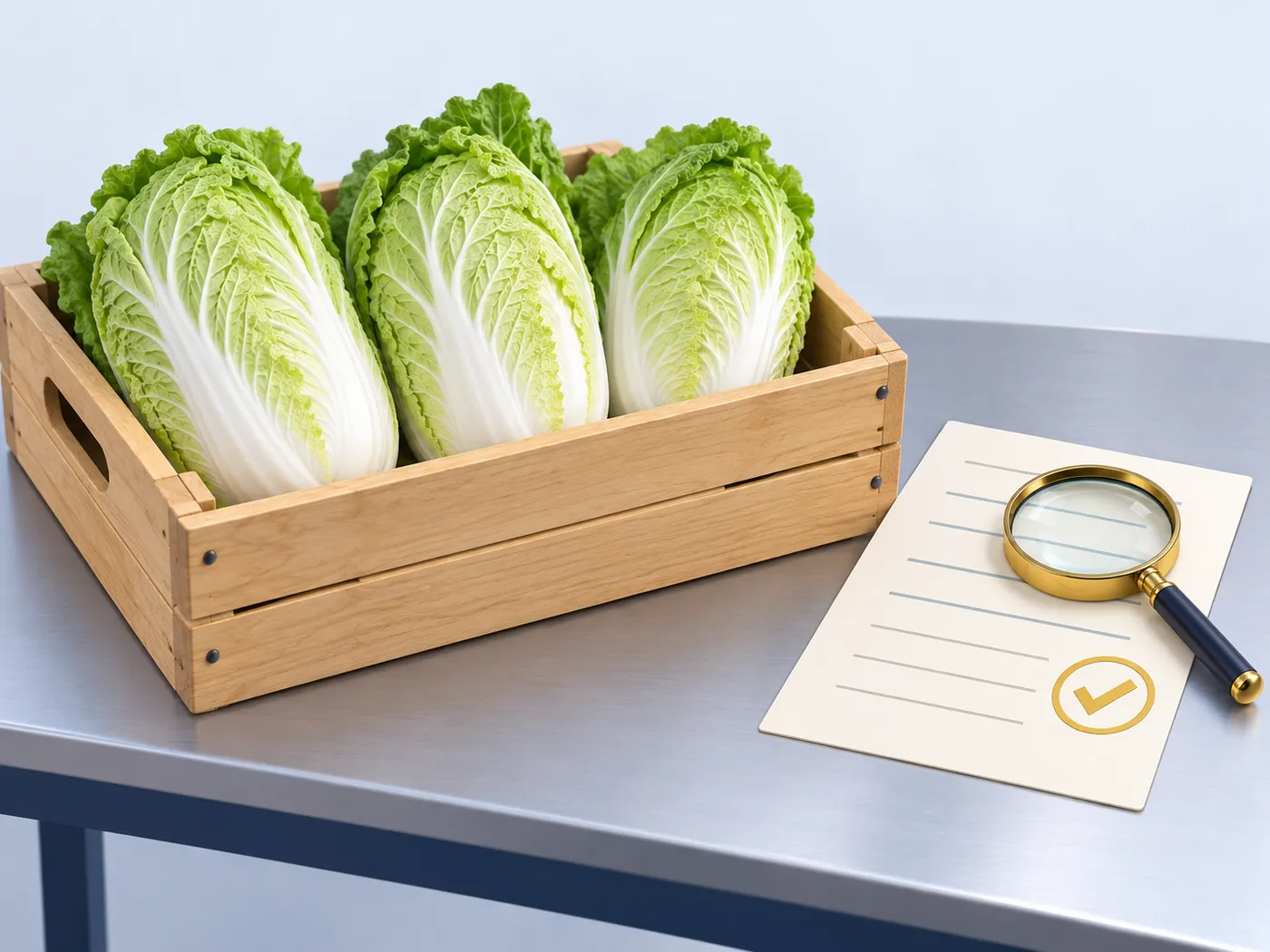
| Item | Before 2026-10-08 | From 2026-10-08 |
|---|---|---|
| Import regulations | B01 F01 MW0 | 465 B01 F01 MW0 |
| Chinese cabbage from origins other than mainland China (commercial imports) | Plant quarantine (B01) and food inspection (F01) | A certificate of origin issued by the government of the exporting or producing country or its authorized body is also required |
| Personal use, not exceeding 6 kg in total of the same type | No certificate of origin required | Still exempt from the certificate of origin (465 item (5)); quarantine and food inspection are still required |
| Chinese cabbage produced in mainland China | MW0, may not be imported | MW0, may not be imported (unchanged) |
- The original announcement does not state why it was added, and does not mention Vietnam. “Chinese cabbage from mainland China suspected of being transshipped to Taiwan via Vietnam” is what media reports said (for example, the Central News Agency on 2026-09-24), and this article does not treat it as an official finding.
- In TFDA border inspection notices, the 7 records of non-compliant Chinese cabbage (napa) exported from Vietnam (tariff code 0704.90.10.00-8) published from 2025-07-22 to 2025-09-23 were all due to pesticide residues (thiamethoxam, thifluzamide, triclosan), 18,000 to 23,250 kg per batch, and were returned or destroyed. A certificate of origin and food inspection are two separate matters: even with a certificate of origin, the goods must still pass inspection.
- Cauliflower, broccoli and other brassica vegetables (cabbage is classified here based on inspection cases), which are also under 0704, were already listed under 465 in the 2019-12-30 announcement, effective 2020-07-01; Chinese cabbage was not on the list then and has only now been added.
- Repacking, packaging or relabeling in a third country does not change the origin: under the Rules of Origin for Imported Goods, the origin of a plant product harvested in a country is the place of harvest; sorting, grading, repacking, packaging and relabeling do not count as substantial transformation.
No. HowBridge only does consolidated shipping from mainland China to Taiwan; Chinese cabbage produced in mainland China is MW0 (goods originating from mainland China may not be imported), cannot be imported with any document, and is not covered by the rule allowing small quantities of mainland China goods to be imported without an import permit. Please do not send fresh Chinese cabbage.
Can these goods be sent from mainland China? Is it still not allowed with a certificate of origin?
No. Chinese cabbage, garlic, peanuts, adzuki beans, cabbage, small abalone, dried shiitake mushrooms, dried wood ear mushrooms and tea produced in mainland China are all MW0 and may not be imported under Article 7 of the Regulations Governing Trade between the Taiwan Area and the Mainland Area. A certificate of origin is meant to prove that goods are “not produced in mainland China”; it cannot make mainland-produced goods importable.
| Situation | Result | Basis |
|---|---|---|
| Produced in mainland China, tariff code listed MW0 | Import not permitted | Article 7 of the Regulations Governing Trade between the Taiwan Area and the Mainland Area |
| Trying to use the “small-quantity import without an import permit” rule | Not applicable: the rule permitting import of small quantities of mainland China goods without an import permit covers only industrial products in Chapters 25 to 97; agricultural products in Chapters 1 to 24 are not included | Explanation by Keelung Customs |
| Declared under another product name | This is a false declaration of the goods' name; where it involves evading import controls, it is punished under Article 36 of the Customs Anti-Smuggling Act, with confiscation | Customs Anti-Smuggling Act, Article 37, paragraph 1, subparagraph 1, and paragraph 3 |
| Declared under another origin (transshipment via a third country) | False declaration of origin and evasion of import controls; in a Taichung Customs case, punished under Article 36 as applied mutatis mutandis by Article 37, paragraph 3, with confiscation | Taichung Customs reconsideration decision |
| Tariff code listed MP1 (for example some clams, other abalone) | Goods from mainland China are conditionally permitted for import, and the conditions must be checked item by item; most of these are live or fresh aquatic products, and HowBridge does not accept live animals and plants; the conditions for frozen MP1 items must also be checked item by item, so ask customer service before shipping | International Trade Administration code explanation; HowBridge terms of service |
What does “transshipment via a third country” mean?
Mainland China-produced goods are first shipped to a third country such as Vietnam or Thailand and then imported with the third country declared as the origin, commonly called “origin laundering”. The 465 requirement of a certificate from the producing country's government exists so that Customs can check such cases. For the full explanation, see What origin laundering means.
If personal use not exceeding 6 kg is exempt, can I just send it?
Not necessarily. Item (5) of 465 exempts only the one document, the “certificate of origin”; all other rules still apply:
| Rule | Content | Relationship to the 6 kg exemption |
|---|---|---|
| 465, item (5) | Imported for personal use (live animals excluded) in a quantity not exceeding 6 kg is exempt from the certificate of origin; Keelung Customs explains that the quantity is calculated as the total for goods of the same type on the whole declaration (for example, tea regardless of tea type) | This is the 6 kg exemption itself |
| MW0 | Goods produced in mainland China may not be imported | The 6 kg exemption does not lift MW0 |
| B01 quarantine | Quarantine is handled under the list of animals and plants subject to quarantine | Still required |
| Plant Protection and Quarantine Act, Article 17, paragraph 3 | Quarantine objects may not be imported by post; those sent by post are returned or destroyed; exceptions are where the plant quarantine authority has announced an exemption from submitting a quarantine certificate, or where the recipient has applied in advance and been approved | Still applies |
| F01 food inspection | Apply to the TFDA for inspection under the Regulations of Inspection of Imported Foods and Related Products; goods not for sale that meet the announced value and quantity limits may be exempt from applying | Thresholds follow TFDA announcements |
What about the 1 kg carried by travelers?
That is a limit for travelers entering the country, not the 465 threshold. Taichung Customs' Customs declaration guide for inbound travelers lists 6 kg for agricultural, livestock and aquatic products, of which cooked peanuts, cooked garlic, dried shiitake mushrooms and tea may each not exceed 1 kg, and bringing live plants and their fresh products is prohibited. See the summary of personal-use limits.
Why can live small abalone not be exempt?
Item (5) of 465 expressly excludes live animals. Live small abalone, live eel and live clams are live aquatic animals, and even for personal use the 6 kg exemption does not apply.
Article 17, paragraph 3 of the Plant Protection and Quarantine Act refers to “sending by post”. Whether express courier or consolidated shipments are equivalent to post, this article did not find any explicit explanation from the Animal and Plant Health Inspection Agency in the sources checked, so please do not infer it yourself; before sending any fresh or dried agricultural product, please ask HowBridge customer service first.
Is the 465 certificate of origin the same document as an ECFA certificate of origin?
No. The names are similar, but the purposes are completely different:
| Comparison | 465 certificate of origin | ECFA certificate of origin |
|---|---|---|
| Purpose | Proves the origin of the goods so that Customs can check whether they are mainland China goods transshipped via a third country | Applies for the preferential tariff under the ECFA Early Harvest List |
| Issued by | The government of the exporting or producing country, or its authorized body | Handled through the certification procedure under ECFA (see the ECFA Early Harvest List guide) |
| Applicable goods | Tariff codes listed with import regulation 465 (the 65 in this article) | Goods on the ECFA Early Harvest List that meet the rules of origin |
| Relation to mainland China | Most 465 items are listed MW0, and mainland-produced goods may not be imported | ECFA is the Economic Cooperation Framework Agreement between the two sides of the Taiwan Strait |
Further reading
For the ECFA Early Harvest List and certificate-of-origin rules, see ECFA Early Harvest List guide. In addition, the Regulations Governing Certificates of Origin and Certificates of Processing govern the issuance of certificates of origin at Taiwan's export end and are unrelated to import 465.
How did the 465 rule come about? Which items were added in which year?
465 did not first appear in 2019; the timeline follows:
| Date | Event | Source |
|---|---|---|
| 2000-11-09 | 465 added to shallots; some tea tariff codes had it added on the same day and removed on 2007-03-03 | International Trade Administration announced amendment data |
| 2009-07-01 | 465 added to the 3 live eel items | International Trade Administration announced amendment data |
| 2010-08-01 | 465 added to frozen tilapia and frozen tilapia fillets; the announcement states that the aim was to prevent mainland products from being transshipped via a third country | Executive Yuan Gazette (announcement of the Bureau of Foreign Trade, Ministry of Economic Affairs) |
| 2019-10-14 | The Council of Agriculture, Executive Yuan (now the Ministry of Agriculture), after convening the relevant ministries, said it would require certificates of origin for imports of cabbage, garlic, adzuki beans, peanuts and small abalone | Ministry of Agriculture (then the Council of Agriculture, Executive Yuan) news of 2019-10-15 |
| 2019-12-30 | Announcement No. 1087038315 of the Bureau of Foreign Trade, Ministry of Economic Affairs (now the International Trade Administration): amends 14 items and adds 47 agricultural and fishery items to import regulation 465 (the amended items include live eel already listed under 465); also adds the exemption for personal use not exceeding 6 kg | Original text of the International Trade Administration announcement; the 6 kg exemption as relayed by Keelung Customs |
| 2020-07-01 | The above announcement takes effect; scope includes clams, other abalone, cauliflower, dried wood ear mushrooms, dried shiitake mushrooms, tea and prepared eel | As relayed by Keelung Customs; announced amendment data |
| 2023 | Tariff codes for dried shiitake mushrooms, adzuki beans and others were revised, and the new codes retain 465 | International Trade Administration announced amendment data |
| 2026-09-24 | International Trade Administration, Ministry of Economic Affairs announcement No. 1157030111: from 2026-10-08, import regulation 465 is added to fresh or chilled Chinese cabbage (0704.90.10.00-8), which is also placed on the “list of imported goods subject to customs verification assistance”; based on Ministry of Agriculture letter No. 1150240267 of 2026-09-11 | Original text of the International Trade Administration announcement |
| 2026-10-08 | 465 takes effect for Chinese cabbage | Original text of the International Trade Administration announcement |
| 2026-10-19 | The database lists 65 tariff codes with 465 (including Chinese cabbage) | International Trade Administration import and export regulations query; open data |
Now in effect. As queried on 2026-10-19, the Chinese cabbage tariff code is 465 B01 F01 MW0 and has been added to this article's 65-item table. The original announcement does not state why it was added; “suspected transshipment via Vietnam” is what media reports said, not part of the announcement. For details, see Why Chinese cabbage needs 465.
How are false declarations of origin and third-country transshipment penalized?
Depending on the circumstances, the same case may involve return of the goods, administrative penalties and criminal liability:
| Situation | Legal consequence | Basis |
|---|---|---|
| Customs notifies the importer to submit 465 documents, and they are not submitted within 2 months | Ordered to return (re-export) the goods within a time limit | Customs Act, Article 96 (explained by Keelung Customs) |
| False declaration of the goods' name or quantity, or submission of false documents | A fine of up to 5 times the import duty evaded, or confiscation of the goods | Customs Anti-Smuggling Act, Article 37, paragraph 1 |
| False declaration involving evasion of import controls (including MW0 mainland China goods) | Under Article 36, a fine of up to 3 times the value of the goods, and confiscation of the goods | Customs Anti-Smuggling Act, Article 37, paragraph 3 applying, mutatis mutandis, Article 36, paragraphs 1 and 3; Ministry of Finance order of 2025-05-06 |
| Smuggling in one shipment goods produced in mainland China in Chapters 1 to 8, peanuts, tea and the like, with a dutiable value of more than NT$100,000 or a weight of more than 1,000 kg | Imprisonment of up to 7 years, with a possible additional fine of up to NT$3,000,000 | Smuggling Punishment Act, Article 2; Executive Yuan announcement of controlled items |
| Importer or exporter violating import restriction rules or falsely labeling origin | A warning, a fine of NT$60,000 up to NT$3,000,000, or suspension of import and export for 1 month up to 1 year | Foreign Trade Act, Article 28 (violation of Article 11, paragraph 2 or Article 17) |
| Packaged food without a label of the place (country) of origin | A fine of NT$30,000 up to NT$3,000,000 | Act Governing Food Safety and Sanitation, Articles 22 and 47 |
| False or misleading food labeling or advertising | A fine of NT$40,000 up to NT$4,000,000 | Act Governing Food Safety and Sanitation, Articles 28 and 45 |
Actual case: mainland black wood ear mushrooms transshipped via Thailand
Taichung Customs reconsideration decision (No. 1021011927): the company shipped mainland China black wood ear mushrooms to Thailand, mixed them with Thai black wood ear mushrooms, and declared them for import at Taichung Port. Customs found that the actual origin of the goods that arrived was mainland China, a false declaration of origin and evasion of import controls; under Article 37, paragraph 3 of the Customs Anti-Smuggling Act applying, mutatis mutandis, Article 36, paragraphs 1 and 3, it imposed a fine of 1 times the value of the goods, NT$347,161, and confiscated the goods, and the criminal part was separately referred to the district prosecutors' office for investigation. That case applied the penalty wording of the time; the current Article 36 provides for up to 3 times the value of the goods.
A common mistake in consolidated shipping
Declaring mainland-produced agricultural products under another product name is “falsely declaring the name of the goods carried” under Article 37, paragraph 1, subparagraph 1 of the Customs Anti-Smuggling Act; where origin is falsely declared to evade import controls, a Taichung Customs case punished it under Article 36 as applied mutatis mutandis by Article 37, paragraph 3. Do not falsely declare product names or origin. For a summary of smuggling criminal liability, see smuggling red lines.
How do I check whether a product needs 465?
Follow the 4 steps below; if you cannot find it or do not understand it, ask customer service before shipping:
1Find the 11-digit tariff code
Find the code according to the product's actual state (fresh, frozen, dried, prepared); the same crop in a different state may have a different tariff code and different rules. For how to read the code, see CCC code explained.
2Check the import regulations at the International Trade Administration
On the import and export regulations query, enter the tariff code and look at the “import regulations” column.
3Read each code
465 = certificate of origin required; MW0 = goods originating from mainland China may not be imported; MP1 = goods from mainland China are conditionally permitted for import; B01 = animal and plant quarantine; F01 = food inspection. For food inspection, see food import inspection guide; for MW0 and import permits, see import permit guide.
4Ask customer service before shipping
Finding no code does not mean the goods can be sent. Fresh and dried agricultural products also involve quarantine and food rules, so please ask HowBridge customer service before shipping.
Where should I report agricultural products suspected of origin laundering?
As checked on the websites of the Ministry of Agriculture and the Animal and Plant Health Inspection Agency on 2026-10-05, the current hotlines are as follows:
| Matter | Hotline | Agency |
|---|---|---|
| Agricultural product smuggling | 0800-054300 | Ministry of Agriculture |
| Smuggling of animal and plant quarantine objects | 0800-039131 | Animal and Plant Health Inspection Agency, Ministry of Agriculture |
| Animal protection (not for reporting smuggling) | 1959 | Ministry of Agriculture animal protection hotline |
How do the Control Yuan, the Legislative Yuan and academic research view this problem?
The reports and studies below provide background; none is directed at HowBridge, and they cannot be used to decide whether an individual shipment can be imported:
- Control Yuan investigation report (case closed 2018-07-04): a company was suspected of importing 80 metric tons of mainland China garlic disguised as Thai garlic; afterwards Customs revised its origin-determination directions, so that for garlic and shiitake mushrooms imported from Asia, clearing whole containers for inspection became the general principle, and the garlic security deposit was raised from 3 times to 4 times the value of the goods.
- Control Yuan corrective measure text (2021-07-20): reviews garlic price monitoring, and mentions origin determination for garlic that failed quarantine, was sent to a third country for processing and then re-imported.
- Legislative Yuan Organic Law and Legislation Bureau issue analysis (2020-02): compiles the penalties involved when quarantine objects from mainland China are hidden in online or postal shipments, including false declaration of country of origin.
- Cheng Tsai-kuang (2012) master's thesis: the methods of smuggling mainland China agricultural supplies by air express through splitting shipments and false declarations.
- Lin Hsing-chun (2013): the impact of cross-strait agricultural trade on Taiwan's economy, which is background to the control policy.
- Lu Hsiu-chen (2017), National Taiwan University master's thesis: at the Taipei fruit and vegetable wholesale market, cabbage and Chinese cabbage (napa) together account for more than 1/5 of total trading volume, and wholesale prices of Chinese cabbage (napa) were all above cost (abstract only).
- Ferrier (2021): after the United States imposed anti-dumping duties on honey from China and Argentina, origin fraud through transshipment to evade the duties was detected using trade and production data (not a Taiwan study; applicable only by analogy).
What do the terms related to 465 mean?
- Import regulation code
- A code that the International Trade Administration, Ministry of Economic Affairs marks on each CCC tariff code to indicate import conditions; on a customs declaration, documents are submitted or procedures completed according to the code.
- 465
- A certificate of origin issued by the government of the exporting or producing country or its authorized body (or a substitute document listed in the provision) must be submitted; goods for personal use (live animals excluded) not exceeding 6 kg are exempt.
- MW0
- Goods originating from mainland China may not be imported.
- MP1
- Goods from mainland China are conditionally permitted for import; the conditions follow International Trade Administration announcements.
- B01
- On import, handle quarantine in accordance with the list of animals and plants subject to quarantine and the related quarantine rules.
- F01
- Apply to the TFDA for import inspection under the Regulations of Inspection of Imported Foods and Related Products.
- Origin
- The country or area where goods are produced or substantially transformed; for plant products, origin is determined by the place of harvest or gathering.
- Transshipment via a third country (origin laundering)
- After products from place A are shipped to a third country, they are imported with the third country declared as the origin.
- Tariff-rate quota code
- Chapter 98 codes, corresponding to goods such as peanuts, adzuki beans, garlic and dried shiitake mushrooms imported within the tariff-rate quota; the import regulations are the same as for the original tariff code.
What are the sources and the scope of checking?
The following sources were consulted on 2026-10-05, and the sources on Chinese cabbage and the number of 465 items on 2026-10-19; document dates are shown separately from consultation dates, and where no date is stated, none has been supplied.
Government and official sources
- Ministry of Agriculture (then the Council of Agriculture, Executive Yuan) news: adding items for which a certificate of origin must be submitted for imported agricultural products (document no. 8388) | Ministry of Agriculture | Document date: 2019-10-15; named cabbage, garlic, adzuki beans, peanuts and small abalone, and required a certificate of origin issued by the producing country's government or its authorized body to be submitted on import; prompted by reports from businesses that mainland agricultural products were suspected of being transshipped via a third country to Taiwan.
- Keelung Customs, Customs Administration, Ministry of Finance news: import regulation code “465” for imported agricultural and fishery products requires a certificate of origin | Keelung Customs, Customs Administration, Ministry of Finance | Document date: 2021-01-26; relays Announcement No. 1087038315 of 2019-12-30 of the Bureau of Foreign Trade, Ministry of Economic Affairs (now the International Trade Administration): 14 items amended and 47 added, effective 2020-07-01; personal use not exceeding 6 kg in total of the same type on the whole declaration is exempt (live animals excluded); where documents are not supplied within 2 months of notification, the goods are ordered to be returned under Article 96 of the Customs Act.
- International Trade Administration, Ministry of Economic Affairs: import and export regulations query (explanations of import regulation codes 465, MW0, MP1, B01 and F01) | International Trade Administration, Ministry of Economic Affairs | Document date: queried 2026-10-19; querying by import regulation code 465 returns 65 tariff codes (including Chinese cabbage 0704.90.10.00-8, added from 2026-10-08 and now listed as 465 B01 F01 MW0); the current 465 provision has 5 items, including the exemption for personal use not exceeding 6 kg. This page requires a form query and has no fixed result URL.
- International Trade Administration, Ministry of Economic Affairs: announced amendment data query (amendment records of import regulations for each tariff code) | International Trade Administration, Ministry of Economic Affairs | Document date: queried 2026-10-05; on 2026-10-05, the amendment records of the tariff codes then listed with 465 were checked one by one (Chinese cabbage was added on 2026-10-08; see the International Trade Administration announcement): most had 465 added on 2020-07-01; live eel (2009-07-01), frozen tilapia (2010-08-01) and shallots (2000-11-09) already had it earlier; tea had it deleted on 2007-03-03 and added again on 2020-07-01.
- Bureau of Foreign Trade, Ministry of Economic Affairs: table of changes to goods import regulations (hard clams, clams, eel, small abalone and others; reposted by overseas missions) | International Trade Administration, Ministry of Economic Affairs (reposted by overseas missions) | Document date: not stated in the file (reposted 2020-01); lists, row by row, the original import regulations and the revised import regulations after 465 was added.
- 465 import regulation, Chinese and English explanation (provisions before and after the amendment of the 2019-12-30 announcement, reposted by overseas missions) | International Trade Administration, Ministry of Economic Affairs (reposted by overseas missions) | Document date: not stated in the file (reposted 2020-02); before the amendment, 465 had only two items (a certificate of origin from the producing country's government, or a document announced as a substitute); after the amendment, an animal quarantine certificate, an official health certificate and the exemption for personal use not exceeding 6 kg were added.
- Executive Yuan Gazette Volume 016, Issue 135: Bureau of Foreign Trade, Ministry of Economic Affairs announcement adding import regulation 465 to 2 items including frozen tilapia | Executive Yuan Gazette | Document date: 2010-07-19; the announcement states that the purpose is to “effectively prevent tilapia products produced in mainland China from being imported into Taiwan via transshipment through a third country”, effective 2010-08-01.
- Central News Agency: to stop Chinese cabbage from China being illegally transshipped to Taiwan, Ministry of Economic Affairs announces imports must be accompanied by a certificate of origin | Central News Agency | Document date: 2026-09-24; news report: the International Trade Administration, Ministry of Economic Affairs announced that import regulation 465 is added to fresh or chilled Chinese cabbage from 2026-10-08; the report says this was prompted by Chinese cabbage produced in mainland China suspected of having been illegally transshipped to Taiwan via a third country (Vietnam). The original announcement does not state why it was added and does not mention Vietnam; “suspected transshipment via Vietnam” is what the media said.
- Taipei Customs, Customs Administration, Ministry of Finance: urging traders and the public to note the supplementary rules on import regulation “465” for imported tea | Taipei Customs, Customs Administration, Ministry of Finance | Document date: 2023-05-11; 465 was added for tea from 2020-07-01, with personal use not exceeding 6 kg exempt; origin is determined by the place of harvest or gathering.
- Foreign Trade Act (Articles 11, 17 and 28) | Laws & Regulations Database of Taiwan | Document date: 2019-12-25; Article 11 is the basis for import restrictions; Article 17 prohibits false origin labeling and applying for certification documents by false means; Article 28 imposes on importers and exporters a fine of NT$60,000 up to NT$3,000,000 or suspension of import and export.
- Regulations Governing Import of Goods (Article 8) | Laws & Regulations Database of Taiwan | Document date: 2023-12-26; on this basis the International Trade Administration announces the list of imported goods subject to customs verification assistance; the 2026 addition of 465 to Chinese cabbage was handled under paragraph 1 of this article (International Trade Administration announcement No. 1157030111).
- Regulations Governing Trade between the Taiwan Area and the Mainland Area (Article 7) | Laws & Regulations Database of Taiwan | Document date: 2024-02-19; goods from the Mainland Area may not be imported into the Taiwan Area unless announced as permitted, which is the legal basis of import regulation MW0.
- Rules of Origin for Imported Goods (Articles 4, 6 and 7) | Laws & Regulations Database of Taiwan | Document date: 2010-12-24; the origin of plant products is the place of harvest or gathering; operations limited to sorting, grading, repacking, packaging or simple drying do not constitute substantial transformation; where origin is in doubt, Customs may require documents or samples evidencing origin.
- Customs Directions for Determining the Origin of Imported Goods (Executive Yuan Gazette Volume 030, Issue 034) | Executive Yuan Gazette | Document date: 2024-02-22; where the origin of imported agricultural and fishery products remains in doubt after determination under the Directions, Customs requests the Ministry of Agriculture to assist in the determination; shiitake mushrooms and garlic are to be inspected batch by batch, and shiitake mushrooms and garlic in the form of whole bulbs are to be sent to the Ministry of Agriculture for identification batch by batch.
- Customs Act (Article 96) | Laws & Regulations Database of Taiwan | Document date: 2022-05-11; for goods that may not be imported, Customs shall order the person liable for duty to return them within a time limit; where the 465 documents are not supplied as notified, this article applies.
- Customs Anti-Smuggling Act (Articles 36, 37 and 39) | Laws & Regulations Database of Taiwan | Document date: 2018-05-09; false declaration of goods' names or submission of false documents is punished by a fine of up to 5 times the import duty evaded; where import controls are evaded, a fine of up to 3 times the value of the goods and confiscation of the goods are imposed under Article 36.
- Ministry of Finance order: meaning of “control” in the Customs Anti-Smuggling Act (No. 1131034572) | Ministry of Finance | Document date: 2025-05-06; “control” includes goods from the Mainland Area that may not be imported under the Regulations Governing Trade between the Taiwan Area and the Mainland Area, and goods whose import the Ministry of Economic Affairs controls under the Foreign Trade Act.
- Taichung Customs, Customs Administration, Ministry of Finance reconsideration decision (No. 1021011927): mainland black wood ear mushrooms transshipped via Thailand with false declaration of origin | Taichung Customs, Customs Administration, Ministry of Finance | Document date: the page does not state one; the origin of the goods that actually arrived was determined to be mainland China; under Article 37, paragraph 3 of the Customs Anti-Smuggling Act applying, mutatis mutandis, Article 36, paragraphs 1 and 3, a fine of 1 times the value of the goods, NT$347,161, was imposed and the goods were confiscated; the criminal part was separately referred to the district prosecutors' office.
- Smuggling Punishment Act (Articles 2 and 3) | Laws & Regulations Database of Taiwan | Document date: 2012-06-13; smuggling controlled goods into the country is punished by imprisonment of up to 7 years, with a possible additional fine of up to NT$3,000,000.
- Executive Yuan announcement “Controlled Items and Control Methods for Controlled Goods”, point 2 (No. 1010047532; secondhand compilation) | Executive Yuan (reposted in a private compilation) | Document date: 2012-07-26; goods of mainland origin not announced as permitted for import in Chapters 1 to 8, rice, peanuts, tea or seeds, smuggled in one shipment with a dutiable value of more than NT$100,000 or a weight of more than 1,000 kg, are controlled imported goods. This provision is taken from a private compilation website; the document number has been cross-checked against the Taichung Customs reconsideration decision.
- Act Governing Food Safety and Sanitation (Articles 22, 28, 30, 45 and 47) | Laws & Regulations Database of Taiwan | Document date: 2019-06-12; packaged food must be labeled with the place (country) of origin; violation of labeling rules is fined NT$30,000 up to NT$3,000,000 under Article 47; false labeling is fined NT$40,000 up to NT$4,000,000 under Articles 28 and 45. Article 30, paragraph 3: imported products not for sale whose value and quantity meet the announced limits may be exempt from applying for inspection.
- Plant Protection and Quarantine Act (Article 17) | Laws & Regulations Database of Taiwan | Document date: 2018-06-20; quarantine objects may not be imported by post, and those imported by post must be returned or destroyed; exceptions are where the plant quarantine authority has announced an exemption from submitting a quarantine certificate, or where the recipient has applied in advance and been approved.
- Taichung Customs, Customs Administration, Ministry of Finance: Customs declaration guide for inbound travelers (limits on agricultural, livestock and aquatic products and mainland China goods) | Taichung Customs, Customs Administration, Ministry of Finance | Document date: 2026-02-03; travelers may carry 6 kg of agricultural, livestock and aquatic products, of which cooked peanuts, cooked garlic, dried shiitake mushrooms and tea may each not exceed 1 kg; carrying live plants and their fresh products is prohibited.
- Keelung Customs, Customs Administration, Ministry of Finance: rules permitting import of small quantities of mainland China goods without an import permit | Keelung Customs, Customs Administration, Ministry of Finance | Document date: the page does not state one; the rule permitting import of small quantities of mainland China goods without an import permit applies only to mainland China industrial products in Chapters 25 to 97 of the tariff; agricultural products in Chapters 1 to 24 are not included.
- Taiwan Food and Drug Administration, Ministry of Health and Welfare: border inspection failures (Vietnamese cabbage, FRESH CABBAGE) | Taiwan Food and Drug Administration, Ministry of Health and Welfare | Document date: 2025-10-14; cabbage exported from Vietnam was declared under tariff code 0704.90.90.90-2, which supports classifying cabbage under this code.
- Ministry of Agriculture website (footer: agricultural product smuggling reporting hotline, animal protection hotline) | Ministry of Agriculture | Document date: consulted 2026-10-05; the footer lists the agricultural product smuggling reporting hotline 0800-054300 and the animal protection hotline 1959.
- Animal and Plant Health Inspection Agency, Ministry of Agriculture, home page (toll-free smuggling reporting hotline) | Animal and Plant Health Inspection Agency, Ministry of Agriculture | Document date: consulted 2026-10-05; lists the toll-free smuggling reporting hotline 0800-039-131.
- Ministry of Health and Welfare news: bulk food must be labeled with the place (country) of origin | Ministry of Health and Welfare | Document date: 2021-01-06; from 2021-01-01, bulk peanuts, adzuki beans, shiitake mushrooms, tea and other foods sold must be labeled with the place (country) of origin.
- International Trade Administration, Ministry of Economic Affairs announcement No. 1157030111 (adding import regulation code 465 to Chinese cabbage) | International Trade Administration, Ministry of Economic Affairs | Document date: 2026-09-24; subject: from 2026-10-08, import regulation code 465 is added to CCC 0704.90.10.00-8 “Chinese cabbage, fresh or chilled”, which is also placed on the “list of imported goods subject to customs verification assistance”; the legal basis is Article 8, Paragraph 1 of the Regulations Governing Import of Goods and Ministry of Agriculture letter No. 1150240267 of 2026-09-11. The original announcement does not state why it was added and does not mention Vietnam.
- Table of changes to import regulations for goods (annex to announcement No. 1157030111) | International Trade Administration, Ministry of Economic Affairs | Document date: 2026-09-24; 0704.90.10.00-8 Chinese cabbage, fresh or chilled: import regulations changed from B01 F01 MW0 to 465 B01 F01 MW0; includes the full official explanations of 465, B01, F01 and MW0, with item (5) of 465 exempting imports for personal use (live animals excluded) of a quantity not exceeding 6 kg.
- Bureau of Foreign Trade, Ministry of Economic Affairs announcement No. 1087038315 (465 amended for 14 items and added for 47 items) | Bureau of Foreign Trade, Ministry of Economic Affairs (now the International Trade Administration) | Document date: 2019-12-30; amends the 465 content for 14 items including live eel and adds 465 to 47 items including live clams, effective 2020-07-01; the annex lists cauliflower and broccoli (0704.10.00.00-7) and other brassica vegetables (0704.90.90.90-2), and Chinese cabbage is not on the list; the announcement states that where a certificate of origin is not provided as required and is not supplied within 2 months from the day after Customs' notice, Article 96 of the Customs Act applies.
- TFDA information on foods failing border inspection: Chinese cabbage (napa) exported from Vietnam (0704.90.10.00-8) | Taiwan Food and Drug Administration (TFDA), Ministry of Health and Welfare | Document date: 2025-09-23; 7 records of non-compliant Chinese cabbage (napa) exported from Vietnam, published from 2025-07-22 to 2025-09-23 (id 5422, 5429, 5430, 5469, 5485, 5501, 5530), all due to pesticide residues (thiamethoxam, thifluzamide, triclosan), 18,000 to 23,250 kg per batch, returned or destroyed. The link is to the 2025-09-23 record.
- International Trade Administration, Ministry of Economic Affairs open data: import and export regulations data for goods (CSV) | International Trade Administration, Ministry of Economic Affairs | Document date: downloaded 2026-10-19; filtering for current import regulations containing 465 gives 65 tariff codes (including Chinese cabbage, effective date 2026-10-08), consistent with HowBridge's tariff data table.
Control Yuan, Legislative Yuan and academic literature
Control Yuan investigation report: a company suspected of importing 80 metric tons of mainland China garlic disguised as Thai garlic (105 Cai-Diao 0047)
A direct case of passing goods off as another origin via a third country; afterwards Customs revised its origin-determination directions, so that clearing whole containers for inspection became the general principle for garlic and shiitake mushrooms imported from Asia, and the garlic security deposit was raised from 3 times to 4 times the value of the goods.
Control Yuan corrective measure text: the Council of Agriculture, Executive Yuan's monitoring of garlic prices and price stabilization measures lack comprehensiveness
Mentions garlic that failed quarantine being sent to a third country for processing and then re-imported; agricultural authorities asked Customs to help with origin determination.
Analysis of the penalties involved when quarantine objects from mainland China are hidden in online or postal shipments
Compiles the penalties under the Animal Infectious Disease Control Act, the Act Governing Food Safety and Sanitation (including false declaration of country of origin), the Smuggling Punishment Act and the Customs Anti-Smuggling Act involved when mainland China quarantine objects are hidden in online purchases and postal parcels.
Opportunity, huge profit, subjective intent: a case study of air express smuggling crime
Describes how air express shipments smuggle mainland China agricultural supplies by splitting shipments and false declarations, directly relevant to the express channel.
A study of sea smuggling crime patterns in the Taiwan area
Analyzes crime patterns of sea smuggling (including agricultural products); background material.
Impact of cross-strait agricultural trade on Taiwan's economy: a regional input-output analysis
Analyzes the impact of opening cross-strait agricultural imports on Taiwan's industries; background to the control policy.
A study of Customs enforcement mechanism strategies in Taiwan
Explains Customs enforcement mechanisms; background material.
A study of marketing channels and prices of cabbage and Chinese cabbage (napa) in Taiwan
At the Taipei fruit and vegetable wholesale market, cabbage and Chinese cabbage (napa) together account for more than 1/5 of total trading volume. The author interviewed farmers, cooperative marketing units, traders and wholesaler-retailers and found that the produce mostly passes through wholesale markets as distribution hubs; cabbage is often overproduced and sold below cost, while wholesale prices of Chinese cabbage (napa) were all above cost, making it more profitable than cabbage. Taiwan study; abstract only, and the abstract does not give the price period or sample size. It can be used to show that Chinese cabbage (napa) is a staple vegetable in Taiwan, and that if cheap transshipped Chinese cabbage flows in, it hits exactly the item on which farmers earn more stable profits.
Detecting origin fraud with trade data: the case of U.S. honey imports
After the United States imposed anti-dumping duties on honey from China and Argentina in 2001, trade patterns showed honey being transshipped to evade the duties, which was later confirmed in criminal cases. The author proposes three methods of flagging suspicious countries using trade and production data, and finds that countries with higher corruption scores were more likely to show suspicious trade patterns after the duties were imposed. Not a Taiwan study; applicable only by analogy; the subject is honey, not vegetables; abstract only. It can be used to show that origin fraud in agricultural products can be detected by “production not matching exports”, the same idea as comparing Vietnam's Chinese cabbage production with its exports to Taiwan.
For the 2019-12-30 announcement, the “exemption for personal use not exceeding 6 kg” relies on the relay by Keelung Customs; for the addition of 465 to Chinese cabbage, the original International Trade Administration announcement and the table of changes have been obtained, but the announcement does not state why it was added, “suspected transshipment via Vietnam” appears only in media reports, and this article found no primary data on 2026 detection records for Vietnamese Chinese cabbage; the provision of “Controlled Items and Control Methods for Controlled Goods” is taken from a private compilation website. This article found no citable primary figures on Chinese cabbage import volumes or countries of origin. This article checked only the 65-item list and the comparison items named in it one by one, and did not exhaust all announcements from 2019 to 2026. This article did not find any explicit text on the value and quantity thresholds of the TFDA's exemption from applying for inspection for goods not for sale, or on the Animal and Plant Health Inspection Agency's view on whether express courier or consolidated shipping equals sending by post.
What are the common questions about the 465 certificate of origin?
What does 465 mean?
Do I need a certificate of origin to send dried shiitake mushrooms or tea from Japan or South Korea to Taiwan?
With a certificate of origin, can I send garlic or peanuts from mainland China?
Are all 465 items prohibited from mainland China?
How is 6 kg for personal use calculated?
If the certificate of origin is waived, can I send fresh agricultural products by express courier or consolidated shipping?
Is the 465 certificate of origin the same as the ECFA certificate of origin?
Do both cabbage and Chinese cabbage need 465?
What documents do I need to import Chinese cabbage from Vietnam or other countries?
What happens if the 465 documents are not supplied?
Which number should I call if I find agricultural products suspected of origin laundering?
Further reading
What origin laundering means: transshipment via a third country and rules of origin
How to read MW0 and import permits
Rules for sending food to Taiwan
Rules for sending Chinese tea to Taiwan
Summary of personal-use limits
F01 food import inspection
CCC tariff code explained
Animal and plant quarantine rules
Smuggling red lines and criminal liability
ECFA Early Harvest List guide
Check the import regulations before shipping
Find the 11-digit tariff code, then check whether the import regulations column has 465, MW0, B01 or F01; before shipping fresh or dried agricultural products, please ask HowBridge customer service.
Look up import regulations by tariff code