Luxury Fountain Pens, Ink and Nibs from Taobao to Taiwan: Tariff Rates, Simplified Declaration, Ink Shipping Rules and Counterfeit Risk
How much tax is due on fountain pens and ink shipped from Chinese online stores to Taiwan, and can they be shipped?
Fountain pens fall under tariff code 9608.30.20.00-8 at a Column 1 duty of 5%; ballpoint pens 9608.10.00.00-6 at 3.4%; nibs 9608.91.10.00-6 at 2.5%; bottled and cartridge writing ink both fall under 3215.90.00.00-6 at 6.5%. Goods originating in mainland China use Column 1, and Customs also collects 5% business tax on top. A batch with a dutiable value of NT$2,000 or less is exempt, but the exemption stops applying once more than 6 duty-free releases have been made within a half-year. The import regulation code for these tariff codes is only "123", and they can generally be cleared by express simplified declaration; if the dutiable value exceeds NT$50,000, or the same batch also contains erasers (C01) or plastic school supplies (C02), a general import declaration is in principle required (but where Customs has announced special circumstances, clearance by simplified declaration may be allowed). HowBridge does not accept glass-bottled ink; ink in plastic bottles or cartridges is a liquid and must be declared to customer service and approved before shipping. Counterfeit fountain pens may not be imported, and Customs may impose an administrative fine of up to three times the value of the goods and confiscate them.
This page explains the tariff, customs clearance and shipping rules for fountain pens, ballpoint pens, ink and nibs bought from mainland Chinese online stores (Taobao, Tmall, JD.com, Pinduoduo and others) and shipped to Taiwan. HowBridge provides mainland China-to-Taiwan consolidation only, through its Shenzhen consolidation warehouse and its Dayuan operations warehouse in Taoyuan; it does not offer consolidation from other countries to Taiwan, and it does not handle import permits or product inspection applications on your behalf. Tariff codes, rates and laws are compiled from the official texts; individual cases are subject to Customs' determination.
What are the tariff codes and duty rates for fountain pens, ballpoint pens, ink and nibs shipped to Taiwan?
All are "pens", but the rates differ: fountain pens 5%, ballpoint pens 3.4%, nibs 2.5%, and writing ink 6.5%. The table below gives the Column 1 rates from the bound 2023 edition (ROC year 112) of the Customs Import Tariff of the Republic of China (Taiwan), published by the Customs Administration, Ministry of Finance (Taiwan); goods originating in mainland China use Column 1. They were cross-checked on 2026-10-18 against the HowBridge tariff database, which syncs weekly with the Customs Administration:
| Product | Tariff code | Official name | Column 1 rate | Import regulation code |
|---|---|---|---|---|
| Fountain pens (including luxury fountain pens) | 9608.30.20.00-8 | Fountain pens | 5% | 123 |
| Ballpoint pens | 9608.10.00.00-6 | Ball point pens | 3.4% | 123 |
| Markers and highlighters | 9608.20.00.00-4 | Felt tipped and other porous-tipped pens and markers | 3.4% | 123 |
| Ink drawing pens | 9608.30.10.00-0 | Ink drawing pens | 5% | 123 |
| Pen gift sets (two or more kinds of pens) | 9608.50.00.00-7 | Sets of articles from two or more of the above subheadings | 4% | 123 |
| Ballpoint pen refills | 9608.60.00.00-5 | Refills for ball point pens, comprising the ball point and the ink-reservoir | 3.4% | 123 |
| Fountain pen nibs | 9608.91.10.00-6 | Pen nibs | 2.5% | 123 |
| Other pen parts | 9608.99.00.00-0 | Other goods of heading 9608 and parts thereof | 2.5% | 123 |
| Bottled ink, cartridge ink | 3215.90.00.00-6 | Other writing or drawing ink and other inks | 6.5% | 123 |
- No commodity tax: the "special collection provisions" column of the tariff is blank for 9608 and 3215, and the commodity tax column of the HowBridge tariff database is empty too, so only customs duty and business tax apply.
- Do not declare ink as printing ink: 3215.11 and 3215.19 are printing inks (black and other colours); writing ink for fountain pens is 3215.90.00.00-6.
- Rollerball pens and ink converters: the official tariff names have no term for "rollerball pen", so they are classified by structure under heading 9608; the HS Explanatory Notes list nib assemblies with a filling device as parts under 96.08; for a stand-alone ink converter, no official classification case was found for 9608.91 or 9608.99. Before shipping, enter the product name in the tariff lookup to check.
- Agreement rate for ballpoint pens: Column 2 for 9608.10 ballpoint pens lists an agreement rate that applies to mainland China (CN), but only with proof of origin and the required documents; no official interpretation was found on whether express simplified declaration can use it, so this page estimates everything at Column 1.
What counts as a "fountain pen" in the tariff? How are gold nibs and ink cartridges classified?
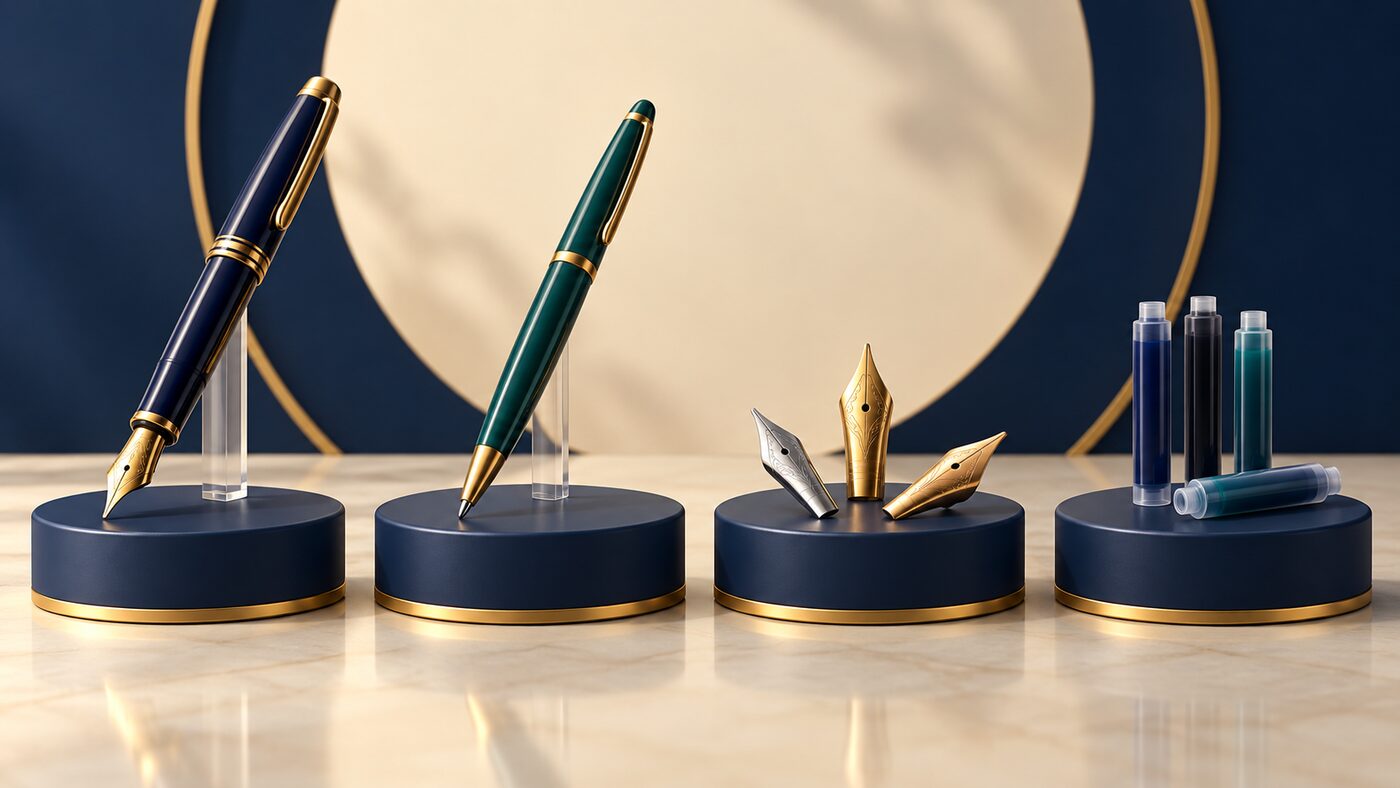
Under the HS Explanatory Notes to heading 96.08, a fountain pen is a pen of the "pump type, with an ink reservoir, push-button, vacuum (suction) tube and so on", whether or not fitted with a nib; nib and tip assemblies are its parts. Three classification rules come up often:
A gold nib or sterling-silver body is still a fountain pen
Chapter 96 Note 4 of the Customs Import Tariff says: "Except for headings 9601 to 9606 and 9615, articles of this Chapter, whether or not wholly or partly of precious metal or of metal clad with precious metal ... remain classified in this Chapter"; Chapter 71 Note 3 also contains an item that expressly excludes "articles which, under Chapter 96 Note 4, are to be classified in Chapter 96". So a fountain pen with an 18K gold nib or a sterling-silver body is still classified under 9608.30.20.00-8 at 5%, not as precious metal goods or jewellery.
Ink cartridges are ink, not pens
The HS Explanatory Notes to heading 96.08 say it "does not include: (a) ink refill cartridges for fountain pens (heading 32.15)"; heading 32.15 states that "cartridges simply containing ordinary fountain-pen ink remain in this heading". Cartridge ink is classified under 3215.90.00.00-6 at 6.5%, the same as bottled ink.
Ballpoint pen refills go under 9608.60
Heading 32.15 does not cover "refills for ballpoint pens, comprising the ball point and the ink-reservoir (heading 96.08)"; such refills fall under 9608.60.00.00-5 at 3.4%.
Novelty pens are still classified by their function as pens
In Customs Administration advance rulings, an animal-shaped toy ballpoint pen was classified under 9608.10.00.00-6 (102AA0357, 2013-05-09) and an erasable highlighter pen under 9608.20.00.00-4 (103AA0051, 2014-01-17); no advance ruling was found for fountain pens, ink or gold nibs themselves.
Can fountain pens and ink go through express simplified declaration? When is a general import declaration needed?
Yes. For fountain pens, ballpoint pens, nibs and writing ink the import regulation code is only "123"; there is no MW0 (mainland goods not permitted for import), no MP1 (conditionally permitted), and no BSMI inspection code C01 or C02. The International Trade Administration's MW0 list (2,514 entries) and MP1 list (862 entries), both downloaded on 2026-10-18, contain no 9608 or 3215 tariff codes, so these goods are not required to use a general import declaration because of "import or export regulations". A general import declaration is still needed in the cases below; Article 12, paragraph 1 lists other cases as well (for example goods eligible for duty reduction or exemption under the rules), which must also be cleared by general import declaration, and an express consignment must have a gross weight of 70 kg or less per piece (bag):
| Situation | Clearance method | Basis |
|---|---|---|
| Dutiable value of the batch NT$2,000 or less | Simplified declaration, low-value duty-free (not available after more than 6 releases in a half-year) | Article 11 of the Regulations Governing Customs Clearance of Air Express Consignments (Taiwan); Article 49, paragraph 2 of the Customs Act (Taiwan) |
| Dutiable value of the batch NT$2,001 to NT$50,000 | Simplified declaration, low-value dutiable (customs duty and business tax apply) | Article 11 of the Regulations Governing Customs Clearance of Air Express Consignments (Taiwan) |
| Dutiable value over NT$50,000 (for example a high-priced luxury pen) | General import declaration (high-value express consignment) | Article 12, paragraph 1, item 1 of the Regulations Governing Customs Clearance of Air Express Consignments (Taiwan) |
| Same batch also contains erasers (4016.92, import regulation code 123 C01) | In principle a general import declaration (import or export regulations apply; but where Customs has announced special circumstances, clearance by simplified declaration may be allowed) | Article 12, paragraph 1, item 2; import regulation open data of the International Trade Administration (Taiwan) |
| Same batch also contains plastic office or school supplies (3926.10, import regulation code 123 C02) | In principle a general import declaration (same as above) | Same as above |
| Counterfeit goods | Not an express consignment, and may not be imported under Article 15 of the Customs Act (Taiwan) | Article 6 of the Regulations Governing Customs Clearance of Air Express Consignments (Taiwan); Article 15 of the Customs Act (Taiwan) |
- Only erasers are goods subject to inspection: the Bureau of Standards, Metrology and Inspection (BSMI, Taiwan) list of inspected items includes "erasers (limited to erasers for removing pen marks, not including erasers attached to stationery accessories)"; an eraser fixed to a pencil is not covered. No inspection announcement was found for fountain pens, ballpoint pens, ink or nibs.
- Quantity: no announced limit on the number of fountain pens or bottles of ink was found; whether the goods are for personal use or have a commercial character is decided by Customs case by case.
- How the dutiable value is worked out: Article 29 of the Customs Act (Taiwan) takes the transaction value (the price actually paid or payable) as the basis; where the transaction value cannot be used, the value is determined in turn from identical goods, similar goods, the domestic selling price (less the usual profit, expenses and so on) and reasonable methods, not directly from the Taiwan retail price.
Before a simplified declaration you must complete the customs authorization (for example EZ WAY identity verification), and check the item name and amount when you receive the declaration notification. For the steps, see EZ WAY identity verification and declaration confirmation guide.
How do the NT$2,000 exemption, the 6-per-half-year limit and business tax work?
If the dutiable value of a batch is NT$2,000 or less, customs duty and the business tax and commodity tax that Customs collects are waived; above that, customs duty applies by tariff code, plus 5% business tax. The rules and their primary sources:
- Low-value exemption: the exemption limit of NT$2,000 set in Ministry of Finance notice No. 1061018778 of 2017-09-07; the Customs Administration's express consignment FAQ says that where the dutiable value of a batch of imported goods is NT$2,000 or less, customs duty and the business tax and commodity tax collected by Customs are waived.
- 6 times per half-year: if the same taxpayer has had duty-free releases more than 6 times within a half-year period (months 1–6 and 7–12 of the year), imports are considered frequent and the exemption no longer applies; the count follows the import date on the declaration and restarts on January 1 and July 1 each year (Ministry of Finance order No. 1061011007 of 2017-05-26).
- Above NT$2,000: customs duty is 5% for fountain pens, 6.5% for ink, 2.5% for nibs and 3.4% for ballpoint pens, plus 5% business tax; no commodity tax applies to 9608 or 3215.
- Do not split orders to avoid tax: if you split a batch of pens and ink into several small parcels, every duty-free release still counts toward the 6 per half-year; the declared price must match the actual transaction price.
Use the Taobao duty calculator to estimate taxes from the product price; if you are unsure of a tariff code, use the tariff lookup. Estimates are for reference only; taxes are subject to Customs' determination.
Can fountain pen ink be shipped? What is the difference between glass bottles, plastic bottles and cartridges?
Article 4.2 of the HowBridge Terms of Service: "Glass, ceramic or other easily broken items are not accepted for shipment on this platform under any circumstances", so HowBridge does not accept glass-bottled ink. Ink in plastic bottles or cartridges contains no glass, but it is a liquid, which the Terms say must be declared in advance and approved by the platform before it can be shipped:
| Ink type | Can it be shipped? | What to watch |
|---|---|---|
| Glass-bottled ink | Not accepted | Clause 4.2: fragile items are never accepted for shipment, and the approval procedure does not apply; if a user ships one without telling HowBridge, no compensation is paid |
| Plastic-bottled ink | A liquid: declare it to customer service and get approval before shipping | Clause 4.2: liquids must be packed properly; clause 7.1: for liquids, no compensation is paid for loss or damage, with or without added insurance |
| Cartridge ink (ink tubes) | A liquid: declare it to customer service and get approval before shipping | Same as above; tariff code 3215.90.00.00-6, rate 6.5% |
| Ink containing alcohol or other flammable ingredients | May be dangerous goods; customer service confirms based on the ingredients | Article 3 of the Regulations on the Administration of Air Transport of Dangerous Goods (Taiwan): Class 3 is flammable liquids, with classification criteria set in the technical specifications |
- Whether ink is an aviation dangerous good cannot be answered in general: Article 43 of the Civil Aeronautics Act (Taiwan) prohibits carrying or consigning dangerous goods onto an aircraft unless they meet the prescribed handling standards; Article 3 of the Regulations on the Administration of Air Transport of Dangerous Goods (Taiwan) puts flammable liquids in Class 3, with classification criteria set in the technical specifications. Whether a given ink is dangerous goods depends on its formulation, and no official document was found stating that ordinary water-based fountain pen ink is not dangerous goods.
- UN number UN 1210 is printing ink: the Hong Kong Fire Services Department dangerous goods database lists UN 1210 as "PRINTING INK", Class 3 (flammable); this is printing ink, not ordinary writing ink.
- Research background: Hagan and Maitland (2025) tested more than 100 fountain pen inks and found that all iron gall inks were highly acidic, with the lowest pH; document inks were mostly neutral to alkaline. This is paper-conservation research, not a transport rule.
Many fountain pen inks come in glass bottles, so check the bottle material on the product page before ordering. HowBridge does not accept glass bottles; if one is shipped without telling us, damage is not compensated. For ink in plastic bottles or cartridges, contact customer service to declare it before shipping, and submit the order only after approval. For the full rules, see the HowBridge Terms of Service.
What should you know before shipping gold-nib pens, sterling-silver pens and high-priced luxury pens?
If a fountain pen has a gold nib or a sterling-silver body, ask customer service whether it can be shipped before sending it. In the tariff it is still a fountain pen under 9608.30.20.00-8 (Chapter 96 Note 4), but the HowBridge Terms of Service have no rule specific to pens containing precious metal, so customer service confirms case by case. High-priced luxury pens also call for the following:
- High-value items must be declared and approved first: Article 4.2 of the HowBridge Terms of Service lists "high-value items" among the goods that must be declared in advance and approved by the platform before shipping; at present, compensation for loss or damage is capped at three times the shipping fee for that item, with insurance to be offered soon, and the Terms suggest reinforced packing and shipping in separate batches. (The above compensation does not apply to precious metals and jewelry: they must first be insured by an insurance company, and HowBridge bears no liability for their loss or damage in transit; see the Terms of Service.)
- A dutiable value over NT$50,000 needs a general import declaration: under Article 12, paragraph 1, item 1 of the Regulations Governing Customs Clearance of Air Express Consignments (Taiwan) it is a high-value express consignment and cannot use simplified declaration.
- Keep proof of purchase: the order, payment record, outer box and warranty card can show the transaction price and source; this is practical advice, not a Customs requirement.
If you buy a counterfeit luxury pen on Taobao, what are the legal risks of shipping it to Taiwan?
Under Article 15, item 2 of the Customs Act (Taiwan), counterfeit goods may not be imported; even for personal use, goods declared for import can still draw an administrative fine of up to three times the value of the goods, plus confiscation. The administrative penalty and criminal liability have different elements:
| Provision | When it applies | Consequence |
|---|---|---|
| Article 39-1 of the Customs Anti-Smuggling Act (Taiwan) | Goods declared for import that "infringe patent, trademark or copyright rights, other than genuine goods imported in parallel"; the article has no "intent to sell" element, so it also applies to personal use | An administrative fine of up to three times the value of the goods, and confiscation of the goods |
| Article 4 of the Standards for Reduction or Exemption of Penalties in Customs Anti-Smuggling Cases (Taiwan) | Applies only to cases where an administrative fine is due under Article 36, paragraph 1 or 2, or Article 37, paragraph 3 of the Anti-Smuggling Act and the dutiable value does not exceed NT$5,000; counterfeit cases under Article 39-1 are outside its scope | Even within its scope, the proviso expressly excludes goods that "infringe patent, trademark or copyright rights, other than genuine goods imported in parallel" |
| Article 97 of the Trademark Act (Taiwan) (the wording currently in force) | Whoever "knowingly sells goods of the kind in the preceding two articles, or possesses, displays, exports or imports them with intent to sell" | A criminal penalty: imprisonment of up to one year, or detention, or a criminal fine of up to NT$50,000, and the fine may be imposed alone or in addition |
| Article 98 of the Trademark Act (Taiwan) | Goods infringing a trademark right | Confiscated whether or not they belong to the offender |
- Elements of criminal liability: the current Article 97 requires "knowledge", and importing in order to sell or with intent to sell. The version of Article 97 amended on 2022-05-04 deletes "knowingly" (amended together with Articles 95 and 96), but Taiwan's Laws and Regulations Database marks its effective date as "to be set by the Executive Yuan" with no final effective date, so the old text still applies.
- HowBridge does not accept counterfeits: Article 4.1 of the Terms of Service lists "counterfeit and infringing goods" as prohibited; Article 11.2 provides that a user who ships counterfeit or infringing goods and causes the platform loss is fully liable for compensation.
For a full explanation of border enforcement and criminal liability for counterfeits, see Will you be fined for shipping fake goods bought online to Taiwan?.
Which luxury fountain pen brands and Chinese fountain pen brands are common?
Wikidata entries show Montblanc, Pelikan and LAMY as German brands and Pilot, Platinum and Sailor as Japanese brands; Jinhao and M&G (Chenguang) are listed in Wikidata as mainland Chinese, and Hero has its headquarters in Shanghai. The table lists only verifiable brand countries and headquarters locations, with no prices:
| Brand | Country | Headquarters |
|---|---|---|
| Montblanc | Germany | Hamburg |
| Pelikan | Germany, Switzerland | Hanover, Feusisberg |
| LAMY | Germany | Heidelberg |
| Pilot | Japan | Tokyo |
| Platinum | Japan | Tokyo |
| Sailor | Japan | Tokyo |
| Parker | United States, United Kingdom | Newhaven (East Sussex, United Kingdom), London |
| Hero (Shanghai Hero Gold Pen Factory) | Mainland China (no country listed in Wikidata; inferred from the Shanghai headquarters) | Shanghai |
| Jinhao | Mainland China | Shanghai, Jiangxi Province |
| M&G (Chenguang Stationery) | Mainland China | Shanghai |
- The rate depends on the tariff code, not the brand: whatever the brand, fountain pens go under 9608.30.20.00-8 at Column 1 5%, and ink under 3215.90.00.00-6 at Column 1 6.5%.
- China's pen industry: in the introduction of a paper, Zhang et al. (2019, Shanghai University) write that more than 3,000 Chinese companies produce more than 40,000,000,000 ballpoint pens a year, about 80% of the global market, yet the free-cutting stainless steel used for the pen tip was long imported (Taiyuan Iron and Steel announced a successful development in 2017, but the authors judge the result still unsatisfactory); this is background in the paper and concerns ballpoint pens.
How do you ship fountain pens bought on Taobao, Tmall, JD.com or Pinduoduo to Taiwan?
First check the tariff code and rate, then confirm whether the ink and any high-priced items must be declared first, and finally declare truthfully and complete the authorization. In order:
1Check the tariff code and rate
Use the tariff lookup to enter "fountain pen", "ink" and "nib" and confirm the 11-digit codes: fountain pens 9608.30.20.00-8 (5%), writing ink 3215.90.00.00-6 (6.5%), nibs 9608.91.10.00-6 (2.5%).
2Check the type of ink
Glass-bottled ink is not accepted, so check the bottle material before ordering; ink in plastic bottles or cartridges is a liquid and must be declared to customer service and approved before shipping; ink containing alcohol or other flammable ingredients is confirmed by customer service based on the ingredients.
3Ask customer service first about high-priced or precious-metal pens
For pens with a gold nib or sterling-silver body, ask customer service before shipping whether they can be accepted; under the Terms of Service, high-value items must be declared in advance and approved; a dutiable value over NT$50,000 needs a general import declaration.
4Ship to the Shenzhen consolidation warehouse and declare truthfully
Send the online-store order to the HowBridge Shenzhen consolidation warehouse; declare the actual item names such as "fountain pen" and "fountain pen ink" and the actual transaction price; do not mix erasers or plastic school supplies into the same batch, or a general import declaration will in principle be required.
5Complete the EZ WAY authorization and check the notification
Complete the customs authorization before a simplified declaration, and check the item name and amount when the notification arrives; shipping fees follow the rules of the shipping calculator.
How is the shipping fee for fountain pens to Taiwan calculated?
Under the billing rules of the HowBridge shipping calculator: sea express costs NT$50 per unit, where the number of units is the larger of actual weight in kg and volumetric weight, rounded up; air freight costs NT$100 per kg, counts actual weight only, and is rounded up. Fountain pens and nibs are small, so they are mostly billed on actual weight; below 10 kg actual weight a light-parcel surcharge is added (sea express NT$100, air freight NT$120). The actual amount follows the shipping calculator and the bill issued after measuring at the warehouse.
- LCL consolidated sea cargo: ask customer service for a quote based on the goods.
- Shipping fees and taxes are separate: shipping fees are charged by HowBridge; customs duty and business tax are determined by Customs.
What does research say about fountain pen ink, writing instruments and cross-border online shopping?
The studies below give background; none of them was done on HowBridge, and foreign studies can only be applied by analogy:
- China is a major ballpoint pen producer, but pen-tip steel was long imported: Zhang et al. (2019, IOP Conference Series: Materials Science and Engineering, Shanghai University) write in the introduction that more than 3,000 Chinese companies produce more than 40,000,000,000 ballpoint pens a year, about 80% of the global market, but the free-cutting stainless steel for the tip has always been imported; Taiyuan Iron and Steel first announced a successful development in 2017, and the authors judge the actual result still unsatisfactory. This is the paper's background statement about ballpoint pens; it can be applied to fountain pens only by analogy.
- Iron gall ink is the most acidic, and an "archival" label does not mean lightfast: Hagan and Maitland (2025, npj Heritage Science) tested more than 100 fountain pen inks; all iron gall inks were highly acidic, with the lowest pH; document inks were mostly neutral to alkaline; two inks labelled archival, though at pH 7, still faded noticeably. The focus is paper conservation, not corrosion of pens, and the study is not from Taiwan, so it can be applied only by analogy.
- The iron salt in iron gall ink is the main cause of deterioration: de Feber et al. (2000, Restaurator) prepared 12 iron gall inks for accelerated ageing; ferrous sulfate dominated in the corrosion process, while tannic acid and gum arabic actually slowed deterioration. It concerns damage to paper, not to pen nibs, and can be applied only by analogy.
- Whether ink writes wet or dry depends mainly on surface tension: Fritz (2022, Materials & Design) measured the amount of ink left on paper by several commercial fountain pen inks and found that "wetness" depends first on surface tension, then on viscosity and conductivity. Ink bought online may feel different in your own pen; this is an Austrian study and can be applied only by analogy.
- Plasticizers were detected in Chinese plastic stationery, highest in PVC desk mats: Zhao et al. (2023, Chemosphere) measured 16 plasticizers in plastic stationery in China, with a median total content of 1.48×10⁴ μg/g; PVC desk mats had the highest content, and DEHP had the highest share and exposure. They measured plastic stationery, not ink, and it cannot be inferred that all stationery on any platform has a problem.
- Research on handwritten notes: across three studies, Mueller and Oppenheimer (2014, Psychological Science) found that students who took notes on laptops did worse on conceptual questions than those who wrote by hand, because they tended to transcribe verbatim; Van der Weel and Van der Meer (2024, Frontiers in Psychology) found with EEG from 36 university students that handwriting produced broader brain connectivity than typing. Neither is a Taiwan study or about fountain pens; they serve only as background on handwriting culture and should not be written up as conclusions.
- For Taiwanese consumers buying writing instruments, material most affects the sense of refinement: Wu Chun-Tzu (2020, master's thesis, Department of Design, National Taiwan University of Science and Technology) studied National Palace Museum pen products, where "material" had the strongest effect on the "refined / rough" image; most respondents bought cultural-creative products 1–2 times a year and accepted a price of NT$201–400 per item. The subject is cultural-creative pens, and the prices are not fountain pen market prices.
- Taiwanese shoppers buying across borders look at price, convenience and trust: Huang Peng-Chien (2016, master's thesis, Department of Management Information Systems, National Chengchi University) studied consumers who had shopped across borders; price sensitivity, trust, self-efficacy, shopping convenience and product price significantly affected purchase intention, and the introduction also mentions that Taobao's Singles' Day pulled domestic consumers to overseas shopping sites. The study is not about stationery and is older.
What are the common terms for shipping fountain pens to Taiwan?
- Tariff code (CCC code)
- The 11-digit classification code for goods imported into Taiwan, for example 9608.30.20.00-8 for fountain pens; it determines the duty rate and import regulation code.
- Column 1 rate
- Column 1 of the Customs Import Tariff applies to World Trade Organization members; goods originating in mainland China use Column 1.
- Import regulation code 123
- An import regulation code of the International Trade Administration (Taiwan); fountain pens, ink and nibs have only 123, with no MW0, MP1 or inspection code, and this page reads that as "no special import regulation".
- C01 / C02
- Import regulation codes for goods subject to BSMI (Taiwan) inspection; erasers are C01 and plastic office or school supplies are C02, and mixing them in in principle requires a general import declaration (but where Customs has announced special circumstances, clearance by simplified declaration may be allowed).
- Simplified declaration
- Express consignments with a dutiable value of NT$50,000 or less that, in principle, involve no import regulations or similar conditions are cleared with a simplified declaration form; special circumstances announced by Customs are an exception.
- General import declaration
- The formal customs declaration required for high-value express consignments, goods subject to import or export regulations (but where Customs has announced special circumstances, clearance by simplified declaration may be allowed), goods eligible for duty reduction or exemption, and similar cases.
- Dutiable value
- The base price used to calculate customs duty, based on the transaction price of the imported goods.
- Ink cartridge
- An ink tube containing ordinary fountain-pen ink; under the HS Explanatory Notes it is classified in heading 32.15, not as a pen part.
- Iron gall ink
- In the research, a formulation based on ferrous sulfate, tannic acid and gum arabic; Hagan and Maitland (2025) found that all iron gall inks were highly acidic, with the lowest pH.
- Genuine goods imported in parallel
- Importing genuine branded goods that were lawfully obtained abroad; infringing goods that are not genuine parallel imports are penalized under Article 39-1 of the Customs Anti-Smuggling Act (Taiwan).
What sources and verification limits does this page have?
The following sources were viewed on 2026-10-18; document dates and viewing dates are shown separately, and no date is supplied where none was given.
Official, government and HowBridge primary sources
- Customs Import Tariff of the Republic of China (Taiwan), 2023 edition (ROC year 112), bound volume (part 2): Chapter 96 Note 4, heading 9608 (112 edition; download page publication date 2025-01-01 on the Customs Administration site; viewed 2026-10-18): Customs Administration, Ministry of Finance (Taiwan). Fountain pens 9608.30.20.00-8 Column 1 5%, ballpoint pens 9608.10.00.00-6 Column 1 3.4%, pen nibs 9608.91.10.00-6 Column 1 2.5%; Chapter 96 Note 4: articles of heading 9608, whether wholly or partly of precious metal, remain classified in Chapter 96
- Customs Import Tariff of the Republic of China (Taiwan), 2023 edition (ROC year 112), bound volume (part 1): heading 3215 (112 edition; download page publication date 2025-01-01 on the Customs Administration site; viewed 2026-10-18): Customs Administration, Ministry of Finance (Taiwan). 3215.90.00.00-6 "Other writing or drawing ink and other inks" Column 1 6.5%; 3215.11 and 3215.19 are printing inks
- HS Explanatory Notes, 2022 edition (Chinese translation by the Customs Administration): headings 96.08 and 32.15 (2022 edition; download page publication date 2025-01-01 on the Customs Administration site; viewed 2026-10-18): 96.08 does not include "ink refill cartridges for fountain pens (heading 32.15)"; 32.15: "cartridges simply containing ordinary fountain-pen ink remain in this heading"; nib and tip assemblies are parts under 96.08
- Open data on import and export regulations for goods (International Trade Administration, Taiwan) (no date shown (downloaded 2026-10-18); viewed 2026-10-18): the current 9608 tariff codes and 3215.90.00.00-6 have only the import regulation code "123"; for comparison, erasers 4016.92.00.00-3 are "123 C01" and plastic office or school supplies 3926.10.00.00-3 are "123 C02"
- Open data on mainland goods not permitted for import (MW0) (International Trade Administration, Taiwan) (no date shown (downloaded 2026-10-18, 2,514 entries); viewed 2026-10-18): no tariff code under 9608 or 3215 appears in the list
- Open data on mainland goods conditionally permitted for import (MP1) (International Trade Administration, Taiwan) (no date shown (downloaded 2026-10-18, 862 entries); viewed 2026-10-18): no tariff code under 9608 or 3215 appears in the list
- Inspection item schedule for erasers subject to inspection (Keelung Branch, Bureau of Standards, Metrology and Inspection, Ministry of Economic Affairs, Taiwan) (compiled 2018-06-05; viewed 2026-10-18): erasers (limited to erasers for removing pen marks, not including erasers attached to stationery accessories) are goods subject to inspection; no inspection announcement was found for pens, ink or nibs
- HowBridge tariff lookup (the site's tariff database, synced weekly with the Customs Administration tariff) (queried 2026-10-18; viewed 2026-10-18): secondary cross-check: fountain pens 5%, ballpoint pens 3.4% and writing ink 6.5% in Column 1 unchanged to date; the import regulation and commodity tax columns are both empty
- Customs Act (Taiwan) (Articles 15, 29, 31 to 35, 49) (amended 2022-05-11; viewed 2026-10-18): Article 15, item 2: goods infringing a trademark right may not be imported; Article 29: dutiable value is based on the transaction value, and Articles 31 to 35 determine it in turn from identical goods, similar goods, the domestic selling price (less profit and expenses) and reasonable methods; Article 49, paragraph 2: low-value exemption and the proviso on "frequent imports"
- Regulations Governing Customs Clearance of Air Express Consignments (Taiwan) (Articles 6, 11, 12) (amended 2026-02-23; viewed 2026-10-18): Article 11: low-value duty-free at NT$2,000 or less, low-value dutiable from NT$2,001 to NT$50,000, high-value above NT$50,000; Article 12, paragraph 1: high-value express consignments, goods subject to import or export regulations (but where Customs has announced special circumstances, clearance by simplified declaration may be allowed), and goods eligible for duty reduction or exemption must be cleared by general import declaration; Article 6: express consignments do not include goods infringing intellectual property rights
- Regulations Governing Customs Clearance of Sea Express Consignments (Taiwan) (Articles 12, 16) (amended 2026-02-23; viewed 2026-10-18): the conditions for a general import declaration for sea express are the same as for air express (high value, subject to import or export regulations and so on); items subject to inspection or other permit requirements must follow the relevant rules
- Trademark Act (Taiwan) (Articles 95, 97, 98) (amended 2023-05-24; viewed 2026-10-18): for Articles 95 to 97 as amended on 2022-05-04, the effective date is "to be set by the Executive Yuan"; final effective date: not yet set; Article 98: goods infringing a trademark right are confiscated whether or not they belong to the offender
- Trademark Act (Taiwan), version of 2016-11-30 (Article 97, the wording currently in force) (amended 2016-11-30; viewed 2026-10-18): Article 97: whoever "knowingly sells goods of the kind in the preceding two articles, or possesses, displays, exports or imports them with intent to sell" is punished by imprisonment of up to one year, or detention, or a criminal fine of up to NT$50,000, and the fine may be imposed alone or in addition
- Customs Anti-Smuggling Act (Taiwan) (Article 39-1) (amended 2018-05-09; viewed 2026-10-18): goods declared for import that infringe a trademark right, other than genuine goods imported in parallel, draw an administrative fine of up to three times the value of the goods, and the goods are confiscated; the article has no "intent to sell" element
- Standards for Reduction or Exemption of Penalties in Customs Anti-Smuggling Cases (Taiwan) (Article 4) (amended 2026-09-22; viewed 2026-10-18): the administrative fine is waived for cases where a fine is due under Article 36, paragraph 1 or 2, or Article 37, paragraph 3 of the Anti-Smuggling Act and the dutiable value does not exceed NT$5,000; the proviso excludes goods that infringe patent, trademark or copyright rights, other than genuine goods imported in parallel; counterfeit cases under Article 39-1 are outside this article
- Civil Aeronautics Act (Taiwan) (Article 43) (amended 2023-06-28; viewed 2026-10-18): dangerous goods may not be carried or consigned onto an aircraft, unless they meet the Ministry of Transportation's regulations or the international dangerous goods handling standards adopted by the Civil Aeronautics Administration
- Regulations on the Administration of Air Transport of Dangerous Goods (Taiwan) (Articles 3, 5) (amended 2018-12-10; viewed 2026-10-18): Class 3 is flammable liquids, with classification criteria set in the technical specifications; goods that do not comply with these Regulations and the technical specifications may not be carried by air
- Dangerous goods database, UN 1210 (Hong Kong Fire Services Department) (no date shown; viewed 2026-10-18): Hong Kong government data, used only to match the UN number: UN 1210 is PRINTING INK (flammable) Class 3, not ordinary writing ink
- Ministry of Finance order of 2024-05-27, No. 1131014492 (order of 2024-05-27; Customs Administration web page publication date 2025-01-21; viewed 2026-10-18): cites Ministry of Finance notice No. 1061018778 of 2017-09-07 (exemption limit NT$2,000) and order No. 1061011007 of 2017-05-26 (6 times per half-year)
- Express consignment FAQ (Customs Administration, Ministry of Finance, Taiwan) (publication date 2026-07-08; viewed 2026-10-18): a batch with a dutiable value of NT$2,000 or less is exempt from customs duty and the business tax and commodity tax collected by Customs; more than 6 duty-free releases for the same taxpayer within a half-year counts as frequent imports
- HowBridge Terms of Service (Articles 4.1, 4.2, 7.1) (no date shown; viewed 2026-10-18): 4.2: glass, ceramic or other easily broken items are not accepted for shipment on this platform under any circumstances; liquids, paste-like goods and high-value items must be declared in advance and approved by the platform; 7.1: no compensation for loss or damage of liquids, fragile items or dangerous goods, with or without added insurance; 4.1: counterfeit and infringing goods are prohibited
- HowBridge shipping calculator (rates checked 2026-09-12; viewed 2026-10-18): sea express NT$50 per unit, where units are the larger of actual and volumetric weight, rounded up; air freight NT$100 per kg, actual weight only, rounded up; a light-parcel surcharge applies below 10 kg actual weight (sea express NT$100, air freight NT$120)
Research papers
Deep Analysis of Free-cutting Phase and Its Distribution in Japanese SF20T Pen Tip Steel
A Shanghai University team analysed Japan's SF20T pen-tip steel and found its free-cutting phases (MnS, Pb, MnTe) more evenly distributed than in Chinese domestic material. The introduction says more than 3,000 Chinese companies produce more than 40,000,000,000 ballpoint pens a year, about 80% of the world total, yet the pen-tip material was entirely imported; Taiyuan Iron and Steel first announced a successful development in 2017, but the authors say the actual result was unsatisfactory because of poor machinability and high cost. The figures are background in the introduction, not measured in the study; the subject is ballpoint pen tips, so it applies to fountain pens only by analogy.
The lightfastness of modern fountain pen inks: ink selection and consequences for document preservation
Tested more than 100 blue and black fountain pen inks; most were highly light-sensitive, with document and pigment inks as exceptions. Document inks were mostly neutral to alkaline, ordinary inks often acidic; all iron gall inks were highly acidic, with the lowest pH. Inks labelled archival can also fade noticeably. The focus is paper conservation, not pen corrosion, and the study is not from Taiwan, so it applies only by analogy.
Iron-Gall Ink Corrosion: A Compound-Effect Study
Prepared 12 iron gall inks for accelerated ageing; ferrous sulfate, tannic acid and gum arabic all affected the corrosion, with ferrous sulfate dominant, while tannic acid and gum arabic actually slowed deterioration; effects were visible after 3 days of ageing at 90°C and 50% relative humidity. It concerns damage to paper, not to pen nibs, and applies only by analogy.
Identification of fountain pen ink properties which determine the amount put on paper during handwriting
Measured the amount of ink left on paper by lines from several commercial fountain pen inks and ran a principal component analysis against their physicochemical properties. Whether an ink writes "wet" or "dry" depends mainly on surface tension, then on viscosity and conductivity, and some correlations run against intuition. It can illustrate why the feel changes when you change ink; an Austrian study, and only the abstract was read.
Phthalates in plastic stationery in China and their exposure risks to school-aged children
Measured 16 plasticizers in plastic stationery in China, with a total content of 5.56 to 3.46×10⁵ μg/g and a median of 1.48×10⁴ μg/g; PVC desk mats were highest, and DEHP had the highest share, detection rate and exposure. The authors consider that the content and exposure risk of PVC stationery (especially classroom desk mats) is higher than that of many other plastic products for children. They measured plastic stationery, not ink, and it must not be written as all online-store stationery containing plasticizers.
The Pen Is Mightier Than the Keyboard: Advantages of Longhand Over Laptop Note Taking
In three studies, students taking notes on laptops did worse on conceptual questions than those writing by hand, because laptop users tended to transcribe verbatim and process less deeply. A US study that applies only by analogy; there was a correction in 2018 and a replication study in 2019, so it should not be cited as a settled conclusion.
Handwriting but not typewriting leads to widespread brain connectivity: a high-density EEG study with implications for the classroom
With 256-channel EEG on 36 university students, handwriting produced a much broader pattern of brain connectivity than typing. The handwriting used a digital pen, not a fountain pen, the sample is small and the study is Norwegian, so it applies only by analogy; it can serve as background on handwriting culture and should not be overstated.
消費者對國立故宮博物院筆具商品的認知差異
A Taiwan study. It groups the design elements of National Palace Museum pens into 5 categories and 12 items (composition, storage, colour, craftsmanship, material and so on); most respondents bought cultural-creative products 1–2 times a year and accepted a price of NT$201–400 per item; "material" had the strongest effect on the "refined / rough" image. The subject is cultural-creative pens, and the prices are for cultural-creative products in general, not fountain pen market prices.
探討跨境網購購買意圖之決定因素
A Taiwan study. It uses the UTAUT model on consumers who had shopped across borders: "price sensitivity", "trust", "self-efficacy", "shopping convenience" and "product price" significantly affect purchase intention. The introduction mentions that Taobao's Singles' Day pulled consumers to overseas shopping sites. It is not about stationery.
消費者輿情對跨境網購產品銷售量之影響:以淘寶網為例
A Taiwan study. It uses text mining, sentiment analysis and k-means clustering to analyse the link between Taobao product reviews and sales; the author considers cross-border online shopping far more complex than domestic online shopping. The abstract gives no specific numbers, so it serves only as background.
Rates follow the bound 2023 edition (ROC year 112) of the Customs Administration's import tariff, cross-checked against the HowBridge tariff database on 2026-10-18; import regulation codes follow the version of the International Trade Administration open data downloaded on 2026-10-18. Items for which no primary source was found: an official definition of the import regulation code "123"; an official document stating that ordinary water-based fountain pen ink is not an aviation dangerous good; an official classification case for ink converters; an official interpretation of whether the ballpoint pen agreement rate can be used for express simplified declaration; official figures on the value of fountain pens and ink imported from mainland China; the inspection rate for fountain pens and the number of counterfeit fountain pens seized. For ink, the HowBridge Terms contain only "glass and other fragile items are not accepted for shipment" and "liquids must be declared in advance and approved"; they have no express rule for pens containing precious metal, which customer service confirms case by case. The full text of the Ministry of Finance notice of 2017-09-07 and the order of 2017-05-26 has no separate published page, and their reference numbers follow the citation in the Ministry of Finance order of 2024-05-27. None of the studies cited was done on HowBridge.
Fountain pens and ink to Taiwan: frequently asked questions
How much customs duty applies to a fountain pen bought on Taobao and shipped to Taiwan?
What is the tariff code for fountain pen ink?
Is a pen with an 18K gold nib taxed as jewellery?
Can fountain pens go through express simplified declaration?
Does HowBridge ship fountain pen ink in glass bottles?
Can ink in plastic bottles or cartridges be shipped?
Is fountain pen ink an aviation dangerous good?
If I buy a counterfeit Montblanc and ship it to Taiwan, can I be fined even for personal use?
Does Customs use Taiwan's selling price to estimate a pen's value?
Are ballpoint pens made in China exempt from customs duty?
How many fountain pens can I ship at once?
Further reading
Tariff and import regulation lookup
Shipping calculator
EZ WAY identity verification and declaration confirmation guide
Taobao duty calculator
What is a CCC code?
Express vs. postal customs clearance in Taiwan
Will you be fined for shipping fake goods bought online to Taiwan?
Taiwan import ban list
Taobao consolidation guide
Tmall to Taiwan guide
Pinduoduo to Taiwan guide
HowBridge Terms of Service
Before you ship, check the tariff code for fountain pens and ink
Enter the product name to see the 11-digit code, duty rate and import regulation code, and whether simplified declaration is possible.
Look up tariff and rate